
A massive compromise of the Arch Linux ecosystem has revealed how threat actors can weaponize open-source governance processes to transform trusted software repositories into malware delivery networks without exploiting a single vulnerability.
The incident, which initially surfaced as a handful of suspicious package updates in the Arch User Repository (AUR), rapidly expanded into one of the largest package-takeover operations ever documented against a Linux software ecosystem. Researchers, community maintainers, and incident responders ultimately identified more than 400 compromised packages, while subsequent investigations suggested the number of affected repositories may have exceeded 1,500 during various stages of the operation.
The scale of the campaign is notable, but the attack methodology is what makes the incident strategically important.
Unlike traditional cyber intrusions that begin with phishing, credential theft, web exploitation, or malware delivery, the attackers appear to have obtained legitimate control over software packages through normal repository procedures. Once ownership was acquired, malicious build instructions were introduced into trusted packages, allowing malware to be distributed through standard software installation and update workflows.
The operation demonstrates a growing trend across the software supply-chain threat landscape: attackers increasingly target trust relationships rather than software vulnerabilities.
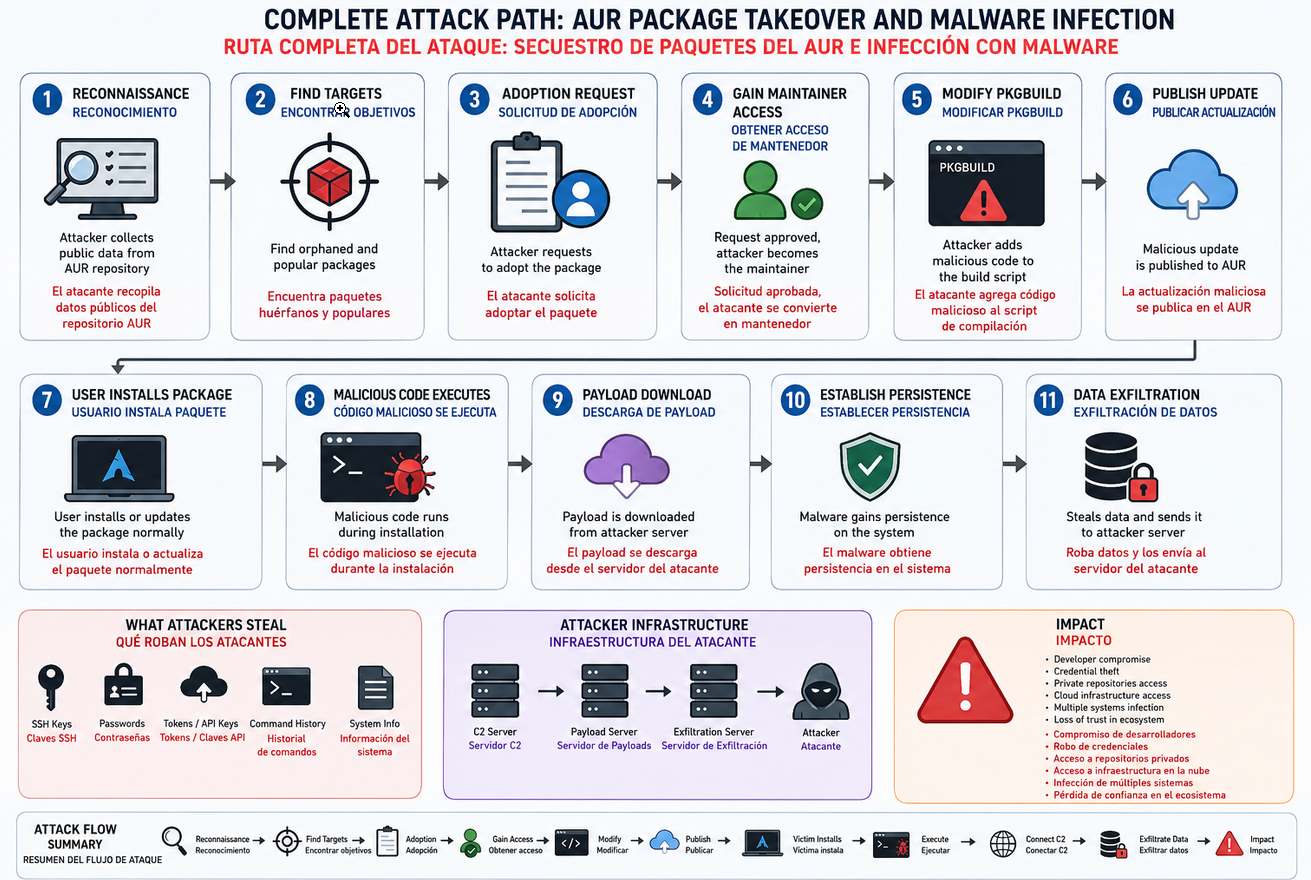
Understanding Why the AUR Became a High-Value Target
The Arch User Repository occupies a unique position within the Linux ecosystem.
Unlike official Arch Linux repositories, which are maintained by trusted project contributors and undergo centralized oversight, the AUR is community-driven. Users publish PKGBUILD files that define how software should be downloaded, compiled, patched, configured, and installed.
The repository contains tens of thousands of packages spanning:
- Development frameworks
- Infrastructure tools
- Security software
- Productivity applications
- Scientific software
- Cryptocurrency utilities
- Desktop applications
- Specialized open-source projects
Many of these packages are maintained by individual volunteers.
Over time, maintainers leave projects, stop updating software, change interests, or simply disappear. To prevent software from becoming permanently abandoned, the AUR allows orphaned packages to be adopted by new maintainers.
That process was designed to strengthen the ecosystem.
Instead, attackers appear to have transformed it into an initial-access mechanism.
Reconnaissance: Building a Target List From Public Repository Data
The first phase of the operation required no exploitation.
Everything needed for targeting was publicly available.
Repository metadata exposes information including:
- Package ownership
- Package popularity
- Vote counts
- Last update dates
- Maintainer status
- Dependency relationships
- Orphan status
- Build instructions
- Source locations
A threat actor can therefore build a comprehensive intelligence database of the entire repository without generating suspicious activity.
A typical automated reconnaissance process would likely include:
Collect AUR Metadata
        ↓
Enumerate All Packages
        ↓
Identify Orphaned Packages
        ↓
Rank by Popularity
        ↓
Map Dependency Relationships
        ↓
Prioritize High-Impact Targets
Particularly attractive targets include packages used by:
- Developers
- DevOps engineers
- Cloud administrators
- Security researchers
- System administrators
- Software engineers
These users often possess privileged credentials capable of enabling secondary compromise operations.
Researchers believe the scale of the campaign strongly indicates the use of automation.
Manually reviewing hundreds of packages would be inefficient.
Automated tooling could continuously scan for:
if package.orphaned == True:
    add_target(package)

if package.downloads > threshold:
    increase_priority(package)

if package.has_many_dependents:
    increase_priority(package)
This transforms the repository into a continuously monitored attack surface.
How Attackers Weaponized the Package Adoption Process
One of the most misunderstood aspects of the incident is that attackers did not necessarily compromise maintainers.
Instead, evidence suggests they frequently became maintainers.
In most software supply-chain attacks, adversaries must:
- Steal maintainer credentials
- Compromise developer endpoints
- Breach source code repositories
- Hijack CI/CD systems
The AUR campaign followed a different path.
Once orphaned packages were identified, attackers could submit adoption requests through legitimate repository procedures.
The workflow is simple:
Package Becomes Orphaned
          ↓
User Requests Adoption
          ↓
Request Approved
          ↓
Ownership Transferred
This mechanism exists to support community maintenance.
However, at scale it becomes susceptible to abuse.
A threat actor can automate adoption requests across hundreds of packages.
Instead of exploiting software, they exploit governance.
The attack chain effectively becomes:
Repository Reconnaissance
          ↓
Find Abandoned Packages
          ↓
Acquire Ownership
          ↓
Become Maintainer
          ↓
Push Malicious Update
          ↓
Distribute Malware
This represents a fundamental shift from traditional intrusion methodologies.
The attacker is no longer breaking into the supply chain.
They are entering through the front door.
Why Identity Verification Was Not a Barrier
Many readers assume such a takeover would be prevented through identity verification.
However, most open-source ecosystems intentionally avoid strict identity requirements.
Repositories including:
- AUR
- npm
- PyPI
- RubyGems
- crates.io
typically identify maintainers through usernames and email addresses.
The reasons are practical.
Open-source projects prioritize:
- Privacy
- Accessibility
- Volunteer participation
- Global collaboration
Requiring government identification would significantly reduce participation and introduce legal and operational complexities.
As a result, an attacker account may appear completely legitimate:
Username: linuxdev42
Email: maintainer@example.com
From a repository perspective, that account may be indistinguishable from a genuine volunteer contributor.
This trust model has historically worked because most participants act in good faith.
The AUR campaign demonstrates how a determined adversary can systematically exploit that assumption.
The Transition From Maintainer to Malware Distributor
Once package ownership was obtained, attackers gained the ability to modify package build instructions.
This stage represents the true compromise.
The AUR does not distribute compiled binaries.
Instead, it distributes build recipes.
These recipes define:
- Download locations
- Build procedures
- Compilation instructions
- Installation steps
- Dependency handling
Because users expect packages to execute build logic, attackers can embed malicious instructions inside otherwise legitimate workflows.
A simplified example:
Download Source Code
        ↓
Compile Application
        ↓
Run Additional Hidden Command
        ↓
Download External Payload
        ↓
Install Malware
To the user, the installation appears normal.
The software installs successfully.
The malicious activity occurs in the background.
Payload Delivery Through External Infrastructure
One of the most effective aspects of the campaign was the separation between the package and the malware.
Instead of embedding malware directly inside package files, attackers could use PKGBUILD logic to retrieve payloads from external infrastructure during installation.
This offers several operational advantages.
Evasion of Static Analysis
Security researchers reviewing package contents may not immediately find malware.
The malicious component exists elsewhere.
Dynamic Payload Updates
Attackers can modify payloads without updating repository packages.
The package becomes a loader.
The infrastructure hosts the malware.
Target-Specific Delivery
Payloads can vary depending on:
- Operating system
- Hostname
- Geography
- User privileges
- Installation environment
This enables selective targeting.
Infrastructure Resilience
If one payload server is removed, another can be substituted without changing package code.
The attack chain becomes:
Package Installation
          ↓
PKGBUILD Executes
          ↓
Remote Server Contacted
          ↓
Payload Retrieved
          ↓
Payload Executed
          ↓
Persistence Established
Malware Objectives: Why Linux Developers Were Attractive Targets
Available reporting indicates the malware focused heavily on credential collection and long-term access.
Researchers identified capabilities associated with:
- SSH key theft
- Authentication token theft
- API key collection
- Shell history collection
- Local credential harvesting
- Persistence mechanisms
- Rootkit-like functionality
- Environment enumeration
These objectives strongly suggest that developers were a primary target population.
A modern Linux workstation often contains access to multiple environments simultaneously.
A single machine may hold:
Developer Laptop
       ↓
GitHub Organization
       ↓
GitLab Projects
       ↓
Cloud Infrastructure
       ↓
Container Registry
       ↓
CI/CD Pipeline
       ↓
Production Systems
From an attacker’s perspective, compromising the developer is often easier than compromising the cloud environment directly.
The workstation becomes the shortest path to privileged infrastructure.
The Hidden Amplification Effect: Dependency-Based Infection
One of the most dangerous aspects of repository attacks is dependency propagation.
A package may only have a few thousand direct users.
However, if that package serves as a dependency for dozens of other packages, the exposure expands dramatically.
For example:
Malicious Library
       ↓
Used By 50 Packages
       ↓
Installed By 100,000 Users
This amplification effect has been observed repeatedly in supply-chain incidents involving:
- npm
- PyPI
- Maven
- Linux repositories
Attackers therefore prioritize software positioned high within dependency chains.
Compromising a single trusted component can create downstream exposure across thousands of systems.
Why This Attack Is Different From Earlier Linux Malware Campaigns
Previous Linux malware campaigns generally relied on:
- Malicious downloads
- Trojanized software
- Fake repositories
- Remote access trojans
- Exploit chains
The AUR operation differs because legitimacy itself became the delivery mechanism.
Every stage of the attack leveraged trusted processes:
Legitimate Repository
          ↓
Legitimate Ownership Transfer
          ↓
Legitimate Maintainer Access
          ↓
Legitimate Package Update
          ↓
Malicious Outcome
No phishing email was required.
No vulnerability was exploited.
No infrastructure breach was necessary.
The attacker inherited trust from the ecosystem.
The Industrialization of Package-Takeover Operations
Perhaps the most significant lesson from the incident is the emergence of package takeover as a scalable attack model.
Historically, supply-chain attacks often targeted:
- A specific developer
- A specific company
- A specific repository
The Arch Linux campaign demonstrates a different approach.
The attackers appear to have treated package acquisition as an automated pipeline.
Conceptually:
Repository Scanning
          ↓
Target Discovery
          ↓
Ownership Acquisition
          ↓
Malicious Modification
          ↓
Mass Distribution
Every stage can be automated.
Every stage can scale.
The result is an attack methodology capable of transforming hundreds of trusted software projects into malware distribution channels with relatively little infrastructure investment.
The broader significance extends far beyond Arch Linux. The operation demonstrates that modern supply-chain threats increasingly focus on governance, ownership, and trust rather than technical exploitation. By systematically identifying abandoned software, acquiring legitimate maintainer privileges, and weaponizing package update mechanisms, attackers showed how repository ecosystems can be converted into large-scale malware delivery platforms without ever breaching the systems that host them. In the era of software supply-chain warfare, ownership itself has become an attack vector.
Information security specialist, currently working as risk infrastructure specialist & investigator.
15 years of experience in risk and control process, security audit support, business continuity design and support, workgroup management and information security standards.