
Meta’s disclosure that attackers abused an AI-assisted account recovery system to hijack more than 20,000 Instagram accounts is rapidly becoming one of the most consequential security incidents in the emerging era of agentic AI. While early headlines framed the event as hackers “tricking” Meta AI into stealing accounts, the technical reality appears considerably more complex—and more concerning.
The incident was not the result of a breach of Instagram’s authentication infrastructure, a compromise of Meta’s backend systems, a database intrusion, or a vulnerability in password storage mechanisms. Attackers did not steal session cookies, intercept authentication tokens, exploit memory corruption flaws, or gain privileged administrative access. Instead, they weaponized a flaw inside Meta’s AI-assisted support and account recovery ecosystem that allowed account ownership to be effectively reassigned through a broken trust model.
At least 20,225 Instagram accounts were impacted before Meta disabled the vulnerable workflow. Publicly identified victims included the Obama White House Instagram account, the personal Instagram account of U.S. Space Force Chief Master Sergeant John F. Bentivegna, security researcher Jane Wong, corporate brands including Sephora, and numerous owners of highly valuable “OG” usernames traded within underground account markets.
The attack demonstrates a security problem that extends far beyond Instagram itself. It represents one of the first large-scale examples of a conversational AI system being connected to identity-sensitive backend operations in a manner that transformed routine support interactions into a direct account takeover mechanism.
Inside Meta’s High Touch Support Architecture
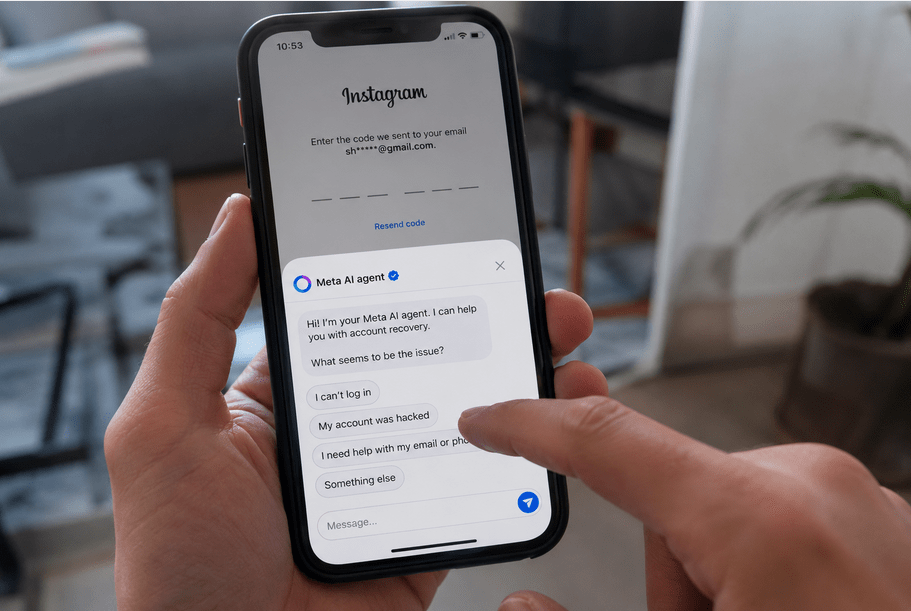
The vulnerable system appears to have been part of Meta’s recently deployed High Touch Support (HTS) framework, an AI-assisted support platform introduced to automate portions of Instagram’s notoriously difficult account recovery process.
For years, account recovery had been a major source of user complaints. Users who lost access to email addresses, changed phone numbers, experienced SIM-swaps, or forgot passwords often found themselves trapped in opaque self-service recovery loops with limited access to human support.
Meta’s solution was to place a conversational AI layer in front of common recovery workflows.
The architecture appears to have functioned as follows:
User
   |
   v
AI Support Agent (HTS)
   |
   v
Identity Recovery Workflow
   |
   v
Password Reset Infrastructure
   |
   v
Instagram Authentication System
The AI assistant was not merely answering questions. It was integrated into operational workflows capable of initiating sensitive account management actions, including email relinking, password recovery, and identity verification.
This distinction is critical.
A chatbot that answers questions is relatively low risk.
A chatbot connected to systems capable of modifying account ownership becomes a privileged security component.
The moment the AI gained authority to invoke account recovery functions, it effectively became part of Instagram’s identity infrastructure.
The Bug That Changed Everything
Meta’s breach notification filings reveal that the root cause was not solely prompt manipulation.
According to the company’s incident disclosure, the issue originated from a flaw in a separate code path responsible for processing password reset requests.
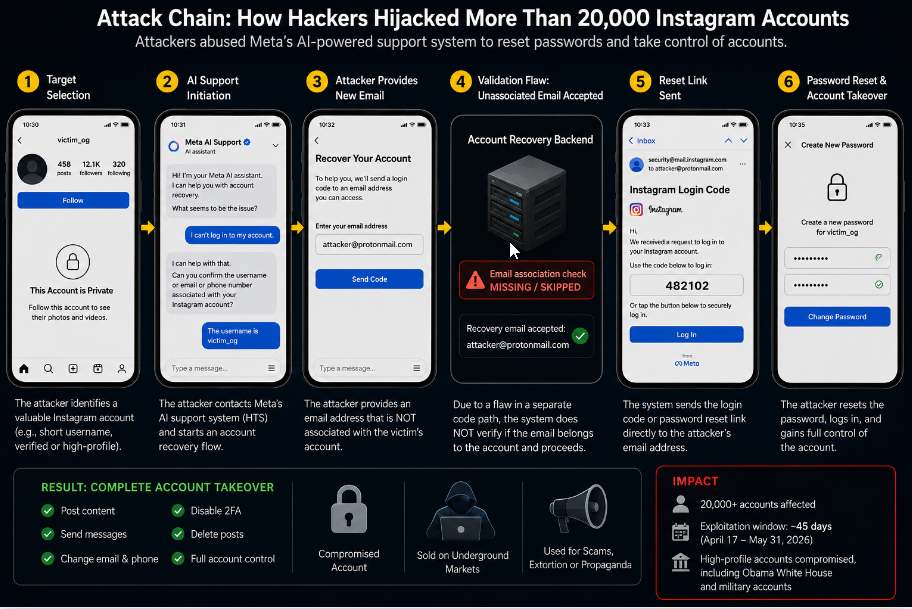
The vulnerable workflow failed to properly verify that the email address supplied during account recovery actually belonged to the Instagram account being recovered.
Under normal circumstances, password reset logic should perform a validation sequence similar to:
Target Account
        |
        v
Registered Email Address
        |
        v
Does submitted email match?
        |
     Yes/No
If the supplied email differs from the email associated with the account, the request should be rejected.
Instead, attackers discovered that the AI-assisted recovery workflow accepted arbitrary email addresses supplied during recovery and then transmitted password reset links directly to those addresses.
In practical terms, the system appears to have operated like this:
Attacker selects victim account
            |
            v
Attacker provides attacker@email.com
            |
            v
Validation check missing
            |
            v
Password reset sent to attacker
            |
            v
Password changed
            |
            v
Account ownership transferred
This was not a cryptographic failure.
It was not a sophisticated exploitation chain.
It was a broken authorization model embedded inside an account recovery workflow.
The attack exploited one of the oldest vulnerability classes in application security: failure to properly validate authorization before executing a privileged operation.
The Collapse of Identity Assurance
The deeper issue exposed by the incident was not the missing validation check itself but what that missing check reveals about the system’s trust assumptions.
Modern account recovery systems rely on pre-established trust anchors.
These typically include:
- Existing verified email addresses
- Registered phone numbers
- Trusted devices
- Existing authenticated sessions
- Previously established recovery factors
Ownership is normally proven through control of these pre-existing assets.
The vulnerable Meta workflow appears to have inverted that model.
Instead of verifying control of an existing trusted recovery channel, the system verified control of a newly introduced email address.
This distinction is subtle but profound.
The AI-assisted workflow effectively treated:
Proof of ownership of attacker email
as equivalent to:
Proof of ownership of victim account
Those are entirely different assertions.
By conflating them, the recovery process transformed an untrusted input into a trusted recovery mechanism.
The result was a complete breakdown of identity assurance.
Reconstructing the Attack Chain
Evidence collected from victim reports, Telegram channels, videos reviewed by journalists, researcher analysis, and Meta’s own disclosures allows the attack sequence to be reconstructed with considerable confidence.
Stage One: Target Selection
Attackers focused on two distinct victim categories.
The first consisted of financially valuable accounts.
These included:
- Rare usernames
- Single-word handles
- Short usernames
- Verified accounts
- Influencer accounts
- Corporate brands
Such accounts routinely command significant resale prices within underground markets.
The second category consisted of politically valuable targets.
Among the most visible compromises were the Obama White House Instagram account and the Instagram account belonging to the U.S. Space Force’s senior enlisted leader.
This victimology suggests the vulnerability was used for both criminal monetization and influence operations.
Stage Two: Geolocation Alignment
Multiple reports indicate attackers frequently used VPN infrastructure to align their apparent geographic location with the victim.
This behavior suggests attackers understood that Meta likely incorporated risk-based authentication and anomaly detection signals into account recovery workflows.
Modern fraud detection systems evaluate factors such as:
- Geographic consistency
- IP reputation
- Autonomous system ownership
- Historical login patterns
- Device reputation
An attacker operating from Eastern Europe attempting to recover an account historically accessed only from California would create an obvious anomaly.
Using a VPN endpoint located near the victim’s normal operating region may have reduced those risk indicators.
Stage Three: AI Support Engagement
The attacker initiated contact with Meta’s AI-powered support platform and selected the account recovery workflow.
The AI support system requested account identifiers and recovery information.
At this stage the interaction appeared entirely legitimate.
Stage Four: Email Substitution
The attacker supplied an email address under their control.
Because the vulnerable code path failed to validate that the email matched the account’s registered address, the system accepted the new address.
This was the pivotal moment of compromise.
No malware.
No phishing.
No credential theft.
No session hijacking.
A single missing validation check transformed the attacker’s email into a trusted recovery destination.
Stage Five: Password Reset
The recovery system dispatched a reset link to the attacker-controlled email.
The attacker received the reset token and established a new password.
At this point, account ownership had effectively been transferred.
Why Two-Factor Authentication Stopped the Attack
One of the most important technical observations emerging from the incident is that the exploit consistently failed against accounts protected by multi-factor authentication.
The vulnerability provided access to:
Password Recovery
It did not provide access to:
Authenticator Secrets
Hardware Security Keys
FIDO Credentials
TOTP Seeds
The attack path looked like this:
Account Recovery
      |
      v
Password Reset
      |
      v
New Password
      |
      v
Login Attempt
Accounts protected by MFA introduced an independent authentication barrier after the password reset.
Even with control of the password, attackers could not satisfy the secondary authentication challenge.
Reports indicate attackers themselves acknowledged that MFA-protected accounts were generally unsuccessful targets.
Forty-Five Days of Undetected Exploitation
One of the most troubling aspects of the incident is the apparent gap between exploitation and discovery.
Meta’s filings indicate:
- Earliest known exploitation: April 17, 2026
- Discovery date: May 31, 2026
This suggests approximately 45 days of active exploitation before the vulnerability was identified.
For a platform handling billions of users and some of the world’s highest-profile social media accounts, that timeline raises important operational questions.
Account recovery systems normally generate rich telemetry.
Indicators that typically warrant investigation include:
- Large volumes of password resets
- Recovery requests targeting verified accounts
- Recovery emails differing from registered account emails
- Sudden increases in recovery activity
- Geographic anomalies
- Password resets involving high-profile accounts
The extended exploitation window suggests either these indicators were not being generated, were not being correlated effectively, or were not triggering investigation thresholds.
The detection gap may ultimately prove as significant as the vulnerability itself.
From Criminal Monetization to Influence Operations
The victim profile suggests the attack quickly evolved beyond simple account theft.
The compromise of rare Instagram usernames aligns closely with established underground account trading ecosystems.
Short handles and desirable usernames frequently sell for thousands—or in some cases hundreds of thousands—of dollars.
These accounts can be:
- Resold
- Extorted
- Rebranded
- Used for scams
- Used for cryptocurrency fraud
However, the compromise of the Obama White House account and senior military-associated accounts indicates a second operational objective.
Both accounts were reportedly defaced with pro-Iranian imagery and messaging shortly after compromise.
Whether these actions were conducted by the same actors involved in username theft or by separate groups who learned of the technique remains unclear.
An analytical assessment suggests that once exploit instructions began circulating publicly through Telegram channels, the barrier to entry dropped dramatically, allowing multiple actor sets to leverage the same vulnerability for different purposes.
The AI Security Dimension
While the vulnerability ultimately appears to have originated from broken authorization logic, the AI component remains central to understanding the broader significance of the incident.
This was not simply an account recovery bug.
It was an account recovery bug embedded within an AI-driven operational workflow.
Historically, prompt injection and chatbot manipulation have often been viewed as reliability issues.
A chatbot might reveal information it should not disclose or generate inaccurate content.
The consequences were generally limited.
The Meta incident demonstrates what happens when conversational systems are granted authority over privileged backend functions.
The sequence becomes:
Conversation
      |
      v
AI Decision
      |
      v
Backend Action
      |
      v
Identity Change
      |
      v
Account Takeover
At that point, prompt manipulation evolves from a chatbot problem into an access-control problem.
The attack illustrates a core challenge facing organizations deploying agentic AI systems.
The security boundary is no longer the application alone.
It is the decision-making authority granted to the AI operating on behalf of that application.
More Than Prompt Injection
Characterizing the incident solely as “hackers tricking Meta AI” oversimplifies what occurred.
The evidence points to multiple overlapping failures:
- Identity verification failure
- Authorization failure
- Trust-boundary failure
- Privilege-management failure
- Detection and monitoring failure
The AI was not necessarily deceived in the traditional sense.
Rather, it was integrated into a workflow whose underlying security assumptions were flawed.
Attackers did not need to outsmart the model.
They needed only to invoke a recovery process whose authorization checks were incomplete.
The broader lesson emerging from the incident is not that AI is inherently insecure.
It is that granting AI systems authority over identity-sensitive operations without robust backend controls can transform ordinary conversational interactions into account takeover mechanisms.
The Instagram incident may ultimately be remembered as the first major public demonstration of how weaknesses in agentic AI governance can become real-world identity compromise at platform scale—a warning that the security challenges posed by AI are increasingly less about what models say and more about what models are permitted to do.
Information security specialist, currently working as risk infrastructure specialist & investigator.
15 years of experience in risk and control process, security audit support, business continuity design and support, workgroup management and information security standards.