
An attack against industrial refrigeration controllers disrupted hundreds of French retail locations, spoiled food and triggered fires. France has attributed the October operation to an Iranian Revolutionary Guard cyber unit. Subsequent incidents across Europe and warnings from US authorities have exposed a much larger problem: the security of remotely managed industrial equipment.
A supermarket’s refrigeration system is not usually considered a national security concern. It is infrastructure designed to preserve food, maintain temperatures and keep stores operating. Yet the equipment responsible for those functions can also become a means of sabotage when its remote management interfaces are accessible to an attacker.

That possibility became reality during the night of October 11–12, 2026, when attackers compromised refrigeration controllers at approximately 700 retail sites in France. Rather than encrypting corporate files, stealing payment information or demanding a ransom, they altered the operating parameters of refrigeration equipment. Defrost settings were changed to force systems into abnormally high-temperature operating conditions, disrupting the cold chain and causing substantial inventory losses. At least 15 fires were reported.
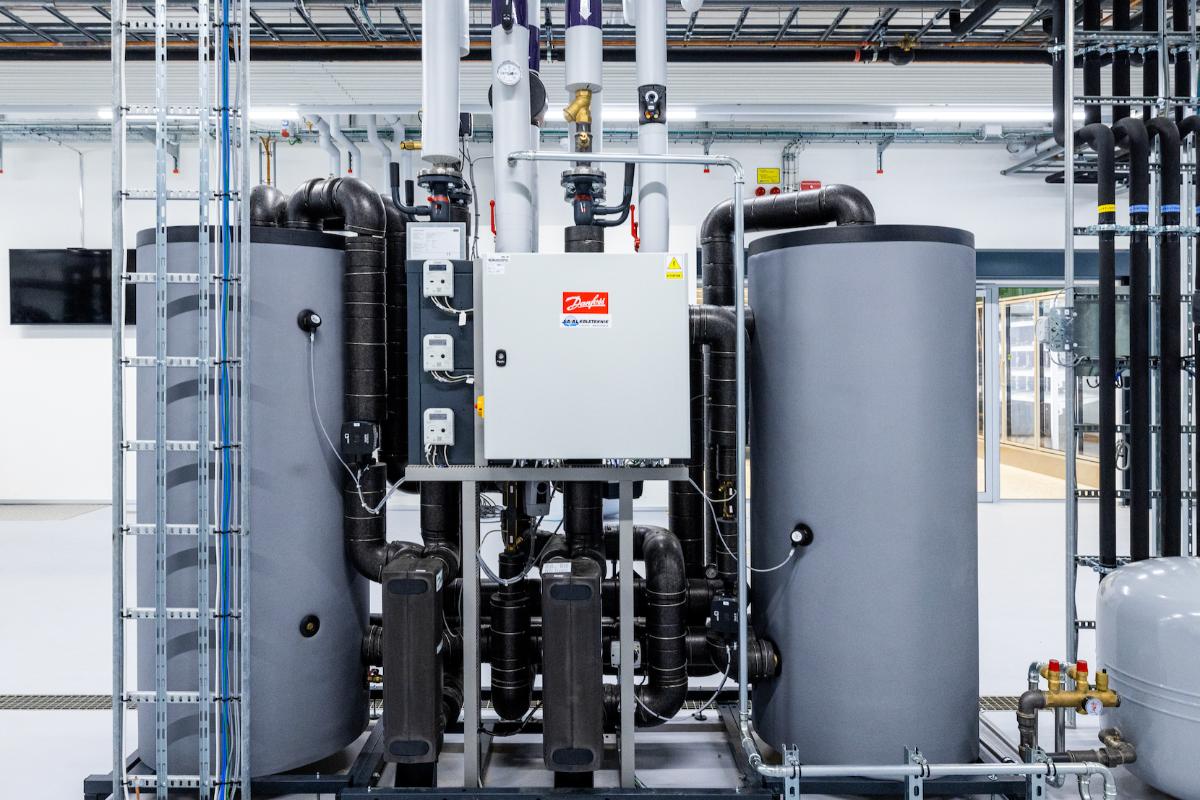
The incident was unusual not because refrigeration controllers had never been exposed to cyberattacks, but because of the scale and physical consequences of manipulating them. The compromised systems were not merely supporting business operations: they were directly controlling machinery in the physical environment.
On November 9, French authorities publicly attributed the October operation to Shahid Kaveh, a cyber-offensive unit affiliated with the electronic and cyber center of Iran’s Islamic Revolutionary Guard Corps (IRGC). The attribution followed a French interagency investigation involving the country’s intelligence and cybersecurity organizations. The next day, The Hacker News reported the government’s findings.
The attribution is significant, but it should not obscure a second finding: the same categories of refrigeration management equipment remain deployed and, in many cases, reachable over the public internet in multiple countries. A second wave of incidents reported on November 2 affected retailers in several European countries. US authorities separately warned of an ongoing threat to industrial refrigeration and cold-chain monitoring systems.
These events expose a security problem that extends well beyond supermarkets. The boundary between an organization’s IT network and its operational technology (OT) is often less clearly defined than security diagrams suggest. A remote maintenance interface intended to help a refrigeration contractor manage hundreds of stores can become an entry point to equipment capable of causing physical damage.
The equipment behind the attack: A remotely managed refrigeration network
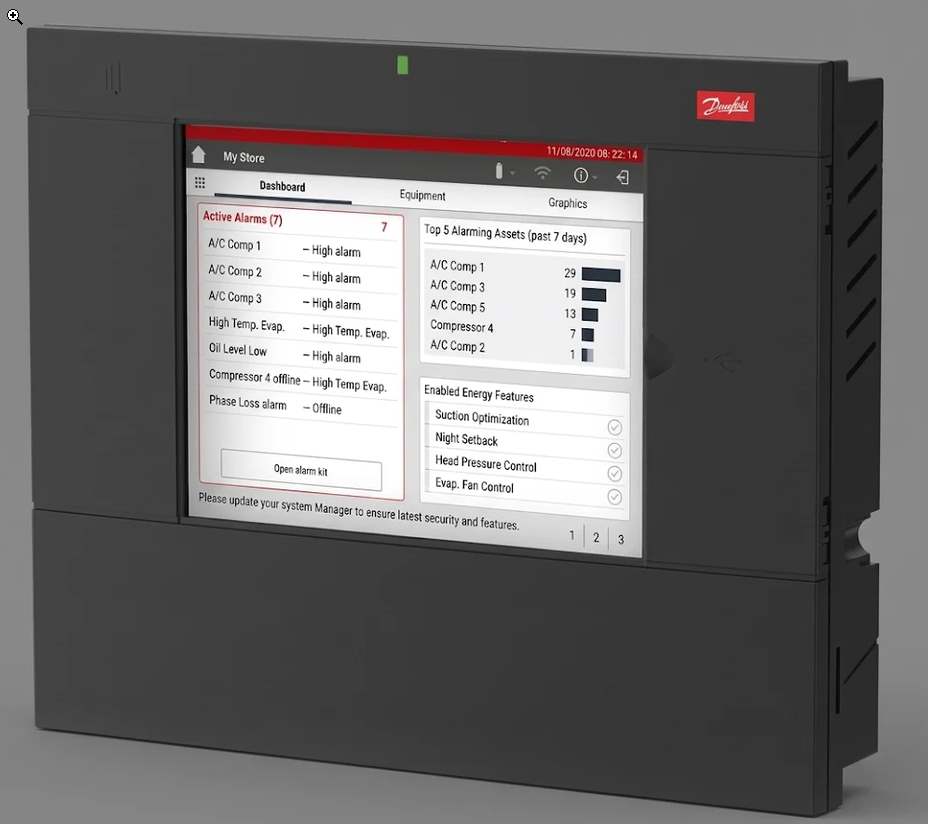
The systems at the center of the French incident belong to a category of industrial technology that is easy to overlook: refrigeration supervisory controllers.
These devices sit between the software used by technicians and the physical machinery responsible for maintaining temperatures. They collect measurements from sensors, coordinate refrigeration circuits and issue commands to equipment such as compressors, fans, valves and defrost heaters.
In a large supermarket, refrigeration is rarely managed as hundreds of independent appliances. A central supervisory controller can monitor multiple display cabinets, freezer sections, cold rooms and refrigeration circuits. An operator can use a browser-based interface to inspect temperature readings, acknowledge alarms, change operating schedules and configure maintenance functions.
That centralization is operationally convenient, but it also creates an attractive attack surface. An attacker who gains administrative control of the supervisory system may be able to influence many refrigeration units without compromising each individual appliance.
One of the principal product families identified in the French investigation was Danfoss’s AK-SM and AK-SC series. The French national cybersecurity agency, ANSSI, and its CERT-FR also identified Copeland XWEB and Dixell XWEB systems in its October 12–16 emergency advisory.
The advisory specifically listed four affected product families:
| Manufacturer | Product family | Function |
|---|---|---|
| Danfoss | AK-SM | Central refrigeration system management |
| Danfoss | AK-SC | Refrigeration system supervisory control |
| Copeland | XWEB | Remote refrigeration supervision |
| Dixell | XWEB | Refrigeration monitoring and management |
The distinction between these products matters. A compressor, temperature probe, refrigeration controller and remote supervisory platform are not interchangeable components. The controller or supervisory platform is the digital management layer through which operational settings can be changed.
CERT-FR reported numerous compromises involving these product families. It did not establish that every product model was compromised in every affected store.
How a refrigeration controller translates software commands into physical behavior
A typical supermarket refrigeration installation can be understood through four interconnected layers.
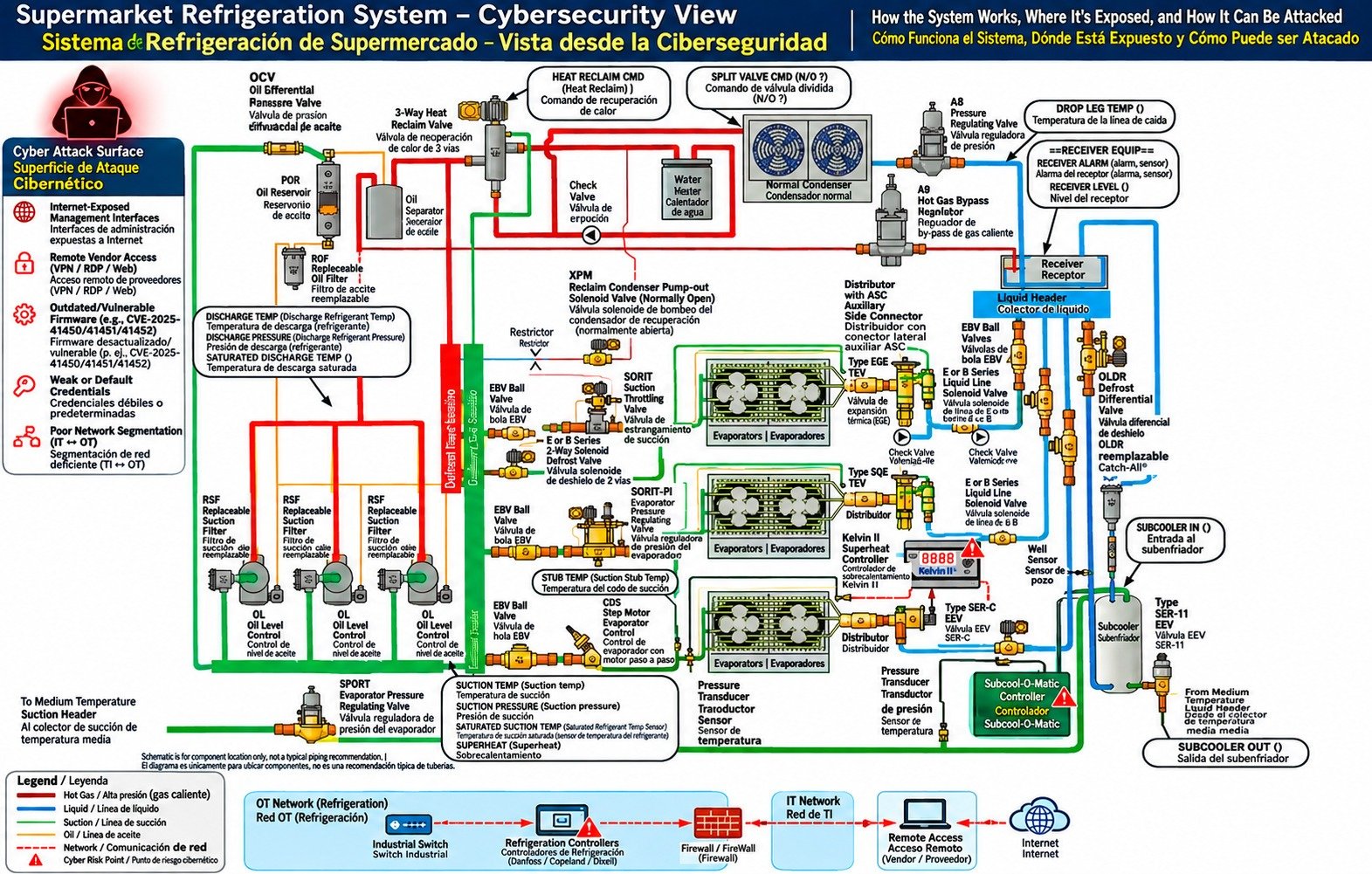
1. Sensing layer
Temperature probes measure the conditions inside refrigerated cabinets, freezers and cold rooms. The measurements are transmitted to controllers, which use them to determine whether cooling is operating within the configured parameters.
2. Control layer
Local controllers execute the configured operating logic. They determine when equipment should operate, when defrost should occur and when alarms should be generated.
3. Supervisory layer
A central management system aggregates information from multiple controllers. Technicians can monitor equipment and change configuration parameters through a management interface.
4. Physical process layer
Compressors, fans, valves and heaters perform the actual work. The commands issued by the control system directly influence the physical refrigeration process.
The supervisory layer is particularly important because it can provide a single point of administrative control over multiple physical devices.
Why the defrost function became a sabotage mechanism
Refrigeration systems periodically need to remove accumulated ice from evaporator coils.
During normal operation, moisture freezes on the evaporator surface. As ice accumulates, it reduces heat-transfer efficiency and restricts airflow. A defrost cycle temporarily changes the refrigeration system’s operating state to remove that ice.
Depending on the installation, this can involve electric heaters, hot-gas defrost or other mechanisms.
A controller normally manages several parameters:
- Defrost frequency.
- Defrost start time.
- Maximum defrost duration.
- Temperature termination thresholds.
- Cooling restart conditions.
- Alarm and safety thresholds.
The attackers manipulated defrost-related parameters, forcing equipment into abnormal high-temperature operating conditions.
The physical consequences followed from the control logic. Equipment designed to maintain low temperatures was instead operating under conditions that disrupted the refrigeration cycle. Food warmed, frozen inventory deteriorated and some installations experienced fires.
This is a fundamentally different type of attack from encrypting a server or deleting a database. The attackers manipulated the operating state of machinery through the same control functions that legitimate technicians use.
The French government’s technical report confirms the modification of defrost parameters. It does not publicly provide a complete device-by-device configuration diff or establish every internal control sequence that preceded the fires.
The vulnerability research that exposed the controllers’ weaknesses
The October attacks did not emerge in a technological vacuum.
Three months earlier, on August 9, 2026, researchers from Claroty Team82 published research into the security of the Danfoss AK-SM 800A.
Their investigation is particularly valuable because it explains how an internet-accessible refrigeration management interface could become a pathway to administrative compromise.
The research identified three vulnerabilities:
| CVE | Vulnerability | CVSS v3 |
|---|---|---|
| CVE-2025-41450 | Improper authentication | 8.2 |
| CVE-2025-41451 | OS command injection | 7.6 |
| CVE-2025-41452 | NGINX configuration injection | 5.4 |
These vulnerabilities affected the AK-SM 8xxA series before the relevant patched firmware releases.
Crucially, the research demonstrates potential attack paths against this controller family. It does not prove that the October attackers used these particular CVEs.
1. The hidden Code-of-the-Day authentication mechanism
CVE-2025-41450
The first discovery involved an alternative authentication mechanism embedded in the controller’s web application.
Team82 examined requests sent to an endpoint named:
xml.cgi
The request-processing logic included an authentication operation identified as:
action="getauth"
During reverse engineering, researchers traced the application into a function named check_code_of_day.
They discovered that the controller contained an alternative authentication path that did not perform the normal verification of the administrator’s configured password.
Instead, the mechanism accepted a specially constructed request containing a daily authentication code.
The code was generated using the device’s date and time.
By reverse engineering the function, Team82 reconstructed the algorithm used to generate that code. This meant that an attacker who understood the algorithm could produce a valid authentication value without knowing the administrator’s actual password.
The significance is substantial.
A conventional authentication system checks whether a user knows the configured secret. This mechanism introduced an alternative path in which knowledge of the date-based algorithm could substitute for that secret.
Successful authentication resulted in a fully authenticated administrative session.
It was not simply an information-disclosure weakness. It could provide access to the controller’s administrative management functions.
Team82 assigned this issue CVE-2025-41450. Claroty+1
2. From authentication bypass to remote code execution
CVE-2025-41451
The second vulnerability demonstrates why weaknesses in embedded management applications can become much more serious than ordinary web-interface bugs.
After obtaining administrative access during its research, Team82 examined how the controller processed configuration changes.
The AK-SM 800A includes functionality for configuring email notifications. This is a legitimate feature: refrigeration controllers need to send alarms and operational notifications to technicians.
However, the researchers discovered that a value supplied through the email configuration interface was incorporated into an operating-system shell command without adequate sanitization.
The problem was not the existence of email notifications. It was the way the application constructed the underlying operating-system command.
Consider the difference between these two programming approaches:
Safe approach:

Validate user input
        |
        v
Pass individual parameters
        |
        v
Execute intended operation
Unsafe approach:
User-controlled input
|
v
String concatenation
|
v
Operating-system shellIn the unsafe approach, input intended to be treated as an ordinary configuration value can potentially be interpreted as shell syntax.
The result is command injection.
Team82 traced this behavior to the email authentication password field, identifying a path to post-authentication remote code execution.
This means an attacker who has obtained the necessary administrative access could potentially move beyond changing application settings and execute commands in the controller’s underlying operating environment.
That distinction changes the security implications considerably. A compromised web-management account can affect the application; remote code execution can potentially compromise the host running the application itself.
CVE-2025-41451 carries a CVSS v3 score of 7.6.
3. NGINX configuration injection
CVE-2025-41452
The third finding involved the embedded NGINX web-server configuration.
NGINX is commonly used as a reverse proxy. It accepts incoming HTTP requests and routes them to the appropriate application component.
Team82 found that the AK-SM 800A included an externally exposed NGINX instance and a configuration file named headers.conf.
The application provided a function that allowed this file to be replaced and the external NGINX service to reload its configuration dynamically.
The relevant operation was named:
load_nginx_headers
The problem was that authenticated users could supply configuration content that influenced how the externally accessible web server handled requests.
Researchers demonstrated that malicious routing directives could be introduced into the configuration. Requests directed at certain maliciously created routes could then trigger an unhandled exception in the sm_app process, terminating the web-management service.
This produced a denial-of-service condition.
The weakness illustrates a broader issue in embedded industrial devices: configuration files are often treated as ordinary administrative data even though they can control security-critical software components.
CVE-2025-41452 received a CVSS v3 score of 5.4.
Danfoss addressed the three vulnerabilities through firmware releases, with Team82 identifying R4.3.1 or later as the relevant release for the vulnerabilities discussed in its research. Claroty
What the research does — and does not — establish
These three vulnerabilities provide a technically credible illustration of how a refrigeration controller can be compromised.
But the distinction between vulnerability research and incident forensics is essential.
The French authorities have not publicly established that the October operation used CVE-2025-41450, CVE-2025-41451 or CVE-2025-41452.
Nor have they published a complete exploit chain, malware sample or forensic reconstruction demonstrating that command injection was used.
The attackers could have gained access through exposed management interfaces, weak authentication, another vulnerability or compromised legitimate credentials. The available evidence does not resolve that question.
Reconstructing the October operation: What investigators know
The French investigation provides enough information to reconstruct the operational sequence, although it does not disclose every step of the intrusion.
The distinction between confirmed activity and inferred technical mechanisms is important. In particular, there is no publicly established evidence of a ransomware payload, a specific malware family, credential-dumping activity or conventional lateral movement through corporate Windows networks.
The documented attack sequence
- Reconnaissance : Operators used FOFA, an internet-connected device search platform, during the operation. This provided a way to identify exposed industrial management interfaces.
- Initial access :Multiple refrigeration controllers were compromised. The precise exploit, credentials or authentication method used to gain access have not been publicly established.
- Administrative control : Attackers obtained sufficient access to manipulate refrigeration operating parameters. Whether they used a vulnerability, legitimate credentials or another access mechanism is unknown.
- Configuration manipulation: Defrost parameters were changed to force high-temperature operating conditions.
- Physical impact :Refrigeration systems malfunctioned, food inventories were lost and at least 15 fires occurred.
Not established in public reporting
- Malware deployment or payload staging.
- Persistence mechanisms or backdoors.
- Credential dumping.
- Lateral movement between corporate IT systems.
- Data collection or exfiltration.
- Specific command-and-control protocols used against refrigeration controllers.
The missing stages are not evidence that they did not happen. They are simply not established by the available public forensic reporting.
How the attackers found their targets
One of the more interesting technical details in the French attribution report is the use of FOFA.
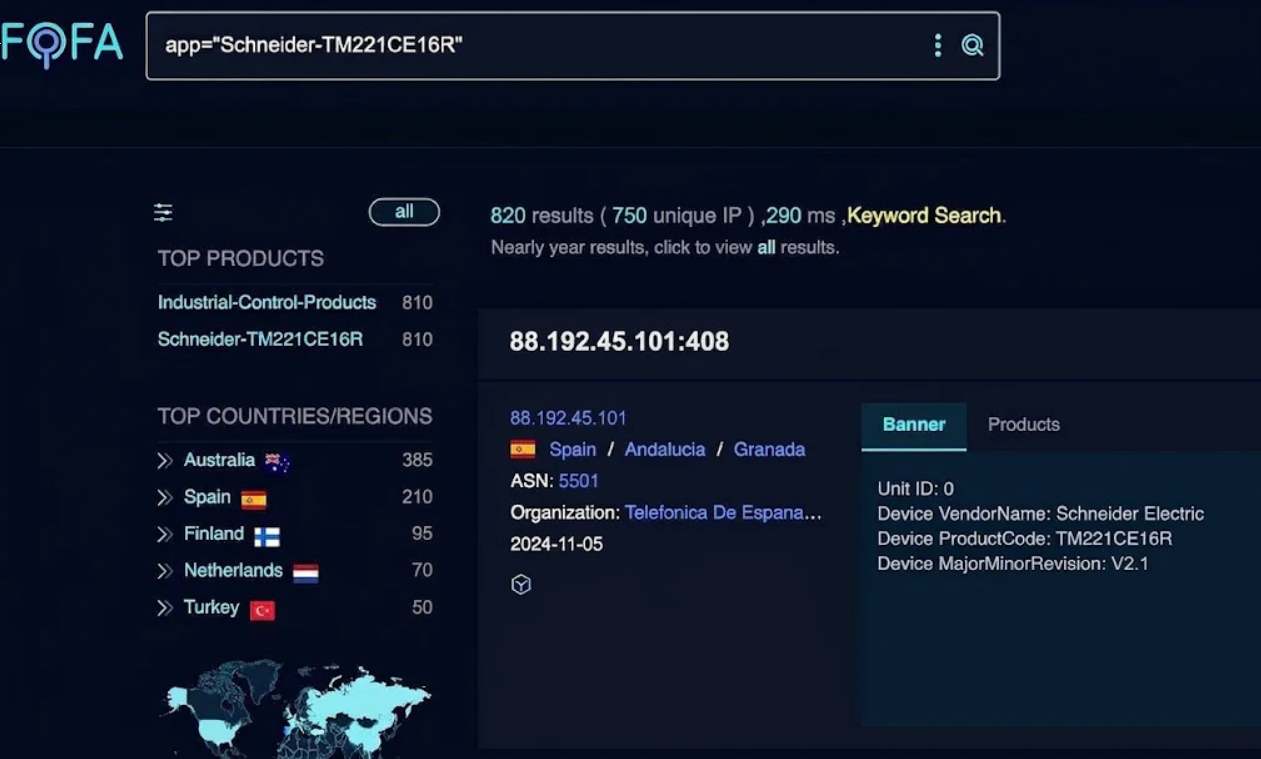
FOFA is a search engine for internet-connected devices and services. Similar to Shodan and Censys, it indexes publicly observable network services and provides search capabilities based on characteristics such as service banners, HTTP responses, certificates and other identifying information.
For an attacker targeting industrial equipment, this changes the economics of reconnaissance.
Without internet-wide search platforms, an operator might have to identify organizations first, enumerate their network infrastructure and then determine which devices were running relevant management software.
With an internet asset search engine, the operator can begin with the equipment itself.
The difference is important:
Traditional targeting:
Organization
    |
    v
Public infrastructure
    |
    v
Network discovery
    |
    v
Industrial equipment
Equipment-oriented targeting:
Industrial product signature
    |
    v
Internet-wide search
    |
    v
Exposed management interfaces
    |
    v
Potential targets
A device’s management interface can expose enough identifying information to reveal its manufacturer, product family or software characteristics.
This does not automatically mean the device is vulnerable. It does mean that the attacker has already reduced the search space.
The French C4 specifically identified FOFA as a tool used during the refrigeration operation and noted that the platform was regularly associated with Shahid Kaveh’s operational activity. CERT-FR+1
Why Modbus appears in the investigation
Another important detail concerns Modbus, an industrial communication protocol widely used by PLCs, controllers and automation equipment.
Modbus allows industrial devices to exchange information and control commands. In its traditional TCP implementation, it commonly operates over port 502.
A supervisory computer can use Modbus to read registers, retrieve equipment status and interact with supported control functions.
The French investigation found that Shahid Kaveh had scripts for scanning, accessing and controlling industrial equipment manufactured by Schneider Electric, Siemens and Rockwell Automation, dating back at least to June 2024.
In April 2026, the group was observed conducting extensive reconnaissance against Schneider Electric equipment using Modbus over TCP port 502.
This activity is particularly relevant because the same French investigation identified simultaneous targeting of Schneider Electric equipment at small hydroelectric facilities.
The C4 linked that activity to the refrigeration operation through shared infrastructure and other indicators.
However, there is an important technical distinction: the French report does not establish that Modbus was the protocol used to manipulate the supermarket refrigeration controllers. Modbus reconnaissance was documented against the Schneider Electric industrial equipment. CERT-FR+1
The attribution: Shahid Kaveh and its industrial sabotage operations
On November 9, 2026, France formally attributed the October refrigeration attacks to Shahid Kaveh, a cyber-offensive unit operating within the IRGC’s Electronic and Cyber Center.
The French investigation was conducted by the Centre de Coordination des Crises Cyber (C4), an interagency body involving:
- ANSSI — National Cybersecurity Agency.
- COMCYBER — French military cyber command.
- DGA — Directorate General of Armament.
- DGSE — External intelligence service.
- DGSI — Internal security and intelligence service.
The attribution was not based solely on an online claim of responsibility.
The C4 published several indicators connecting the operation to Shahid Kaveh.
Four indicators used in the attribution
1. Shared infrastructure
Infrastructure used during the refrigeration attack was also used around the same period for reconnaissance against Schneider Electric equipment at small energy and water production installations.
The techniques associated with this reconnaissance had previously been attributed to Shahid Kaveh.
2. FOFA reconnaissance
The French report identified FOFA as a tool used to locate the refrigeration systems and noted its historical association with the group’s operations.
3. Propaganda amplification
The attack was publicized on CyberbanNews, an online propaganda outlet associated by French authorities with Shahid Kaveh, beginning October 13, 2026.
This is relevant because state-linked cyber operations sometimes use public-facing hacktivist identities to amplify operations and create a layer of separation between the operators and the activity.
4. Persian-language traces
Investigators identified traces of Farsi in the attack infrastructure.
Language artifacts are not independently conclusive evidence of nationality or state sponsorship. Their significance comes from correlation with other technical and operational indicators.
Taken together, the French authorities considered the evidence sufficient to attribute the operation to Shahid Kaveh. CERT-FR+1
The group’s public identities
French authorities identified several online personas associated with Shahid Kaveh:
| Identity | Role |
|---|---|
| CyberAveng3rs | Public hacktivist persona |
| Soldiers of Solomon | Public-facing identity |
| Mr. Soul | Public-facing identity |
| Cyber Isnaad Front | Public-facing identity |
| CyberbanNews | Propaganda and communications outlet |
The identities matter because an operation can have multiple layers:
- The organization conducting the technical operation.
- The infrastructure used to conduct it.
- The public persona claiming responsibility.
- The propaganda channels amplifying the incident.
These layers should not be treated as separate threat actors simply because they operate under different names.
A longer history of attacks against industrial control systems
The refrigeration incident is not an isolated example of Shahid Kaveh’s interest in industrial environments.
The group’s historical activity includes operations against Israeli and US industrial interests.
November 2023: Unitronics industrial controllers
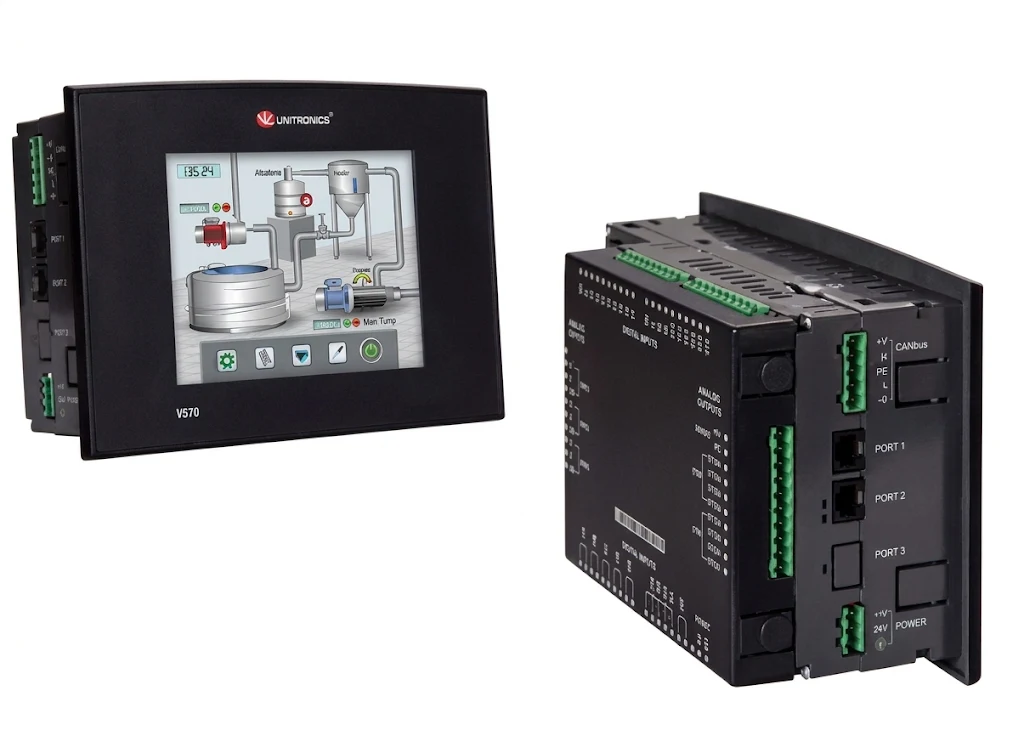
In November 2023, the CyberAveng3rs persona claimed attacks targeting Unitronics programmable logic controllers.
Unitronics manufactures PLC and HMI equipment used in industrial environments, including water and wastewater infrastructure.
The incidents demonstrated the potential consequences of exposing industrial controllers to the internet, particularly where weak or default authentication was present.
The US government previously warned about CyberAveng3rs activity targeting Unitronics PLCs in water and wastewater facilities.
The significance of this historical operation is that the group was already publicly associated with industrial control systems before the French refrigeration incident.
March–April 2026: Industrial sabotage targeting Israeli and US interests
According to the French C4 report, Shahid Kaveh claimed a large-scale sabotage campaign against Israeli and American interests during March and April 2026.
The campaign reportedly included industrial control equipment, including refrigeration equipment in Israel.
This is particularly relevant to the French operation because it shows that refrigeration infrastructure had already appeared within the group’s claimed targeting scope.
The group also possessed scripts, dating back to at least June 2024, for identifying and interacting with industrial equipment from Schneider Electric, Siemens and Rockwell Automation.
The French report therefore describes an actor with an established interest in manipulating industrial equipment rather than a group whose capabilities were limited to website defacement or conventional IT intrusions. CERT-FR+1
November 2: A second wave hits European refrigeration systems
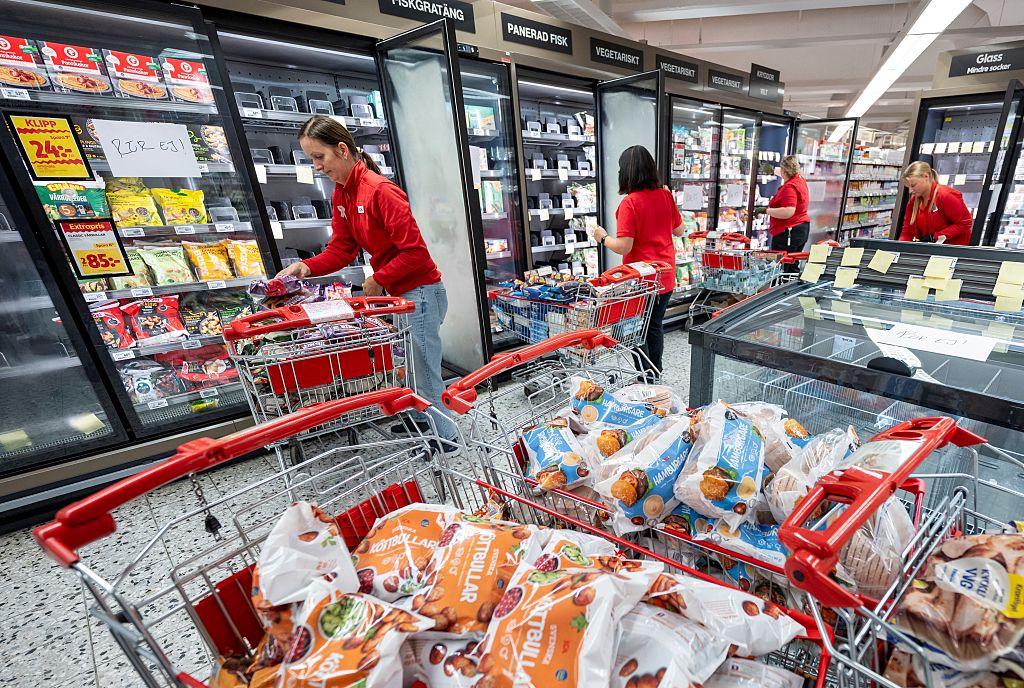
Less than three weeks after the French operation, another series of incidents disrupted refrigeration systems across Europe.
During the night of November 1–2, retailers in several countries reported abnormal temperatures in refrigerated display cabinets and freezers.
The affected businesses included:
| Country | Organizations / businesses reported affected |
|---|---|
| Belgium | Delhaize, Carrefour, Colruyt, Spar and independent businesses |
| Sweden | ICA and Coop |
| Ireland | SuperValu |
| Netherlands | Multiple businesses using refrigeration systems managed by Danfoss |
| Luxembourg | Delhaize operations |
| Estonia | Selver |
| Finland | Reports involving K Group supermarkets |
Reuters reported that some Swedish freezers reached 50°C. In Belgium, Carrefour confirmed that 15 stores were affected, while Delhaize reported problems at several dozen locations.
Musgrave, the owner of SuperValu, confirmed that refrigeration systems at 13 stores were affected.
At least one Belgian butcher estimated losses of approximately €15,000.
In Estonia, a refrigeration technology provider reported unauthorized access to a computer controlling a customer’s refrigeration system. The temperature was raised to approximately 50°C, but the incident was contained quickly.
More than 100 retail locations were affected across the second wave, although exact totals vary across reporting. Reuters+2
Was the second wave conducted by the same Iranian group?
This is where attribution becomes particularly important.
The second wave showed similarities to the French incident:
- Similar target infrastructure.
- Remote manipulation of temperature settings.
- Refrigeration disruption.
- Food losses.
- Activity involving internet-connected refrigeration management equipment.
Censys also observed a broad reduction in exposed Danfoss and Copeland/Dixell systems beginning November 2.
However, neither the similarity of the targets nor the timing proves that the same threat actor conducted both operations.
Reuters reported that investigators had not established whether the November attacks were connected to the French operation.
Unit 42 subsequently reported that the pro-Russian hacktivist groups NoName057(16) and Z-Pentest claimed responsibility through Telegram posts on November 3. Unit 42 described those claims as unverified.
As of November 11, there is no conclusive public attribution of the second wave to Shahid Kaveh.
The French government’s attribution applies to the October attacks in France, not automatically to every subsequent refrigeration incident in Europe. Reuters+2
The United States: Refrigeration failures at military commissaries
The story extends beyond European retail.
In August 2026, several US military commissaries experienced refrigeration failures that resulted in food spoilage.
The incidents affected at least six installations, including:
- Fort Huachuca, Arizona.
- Fort Irwin, California.
- F.E. Warren Air Force Base, Wyoming.
- Naval Station Newport, Rhode Island.
- Columbus Air Force Base, Mississippi.
- Travis Air Force Base, California.
Other reports identified additional affected installations.
At Fort Huachuca, the installation publicly reported that its freezers had entered defrost mode, heating the stored food.
The incidents initially appeared to be equipment malfunctions. However, the cluster of similar failures attracted the attention of military investigators.
By October 29, Reuters reported that Pentagon investigators were treating the incidents as suspected cyberattacks.
The investigation involved US Cyber Command and military investigative organizations, including the Army Criminal Investigation Division.
The US investigation has not publicly established who was responsible or whether the August incidents were connected to the French campaign.
On November 5, the US government escalated its public warning.
A joint factsheet was issued by:
- CISA.
- FBI.
- Department of Health and Human Services.
- Department of Agriculture.
- Department of Transportation.
The agencies described malicious cyber activity targeting industrial refrigeration and cold-chain monitoring systems globally.
They specifically identified three potential attack vectors:
- Authentication bypass.
- Arbitrary code injection.
- Weak configurations.
They also described the possibility of attackers forcing refrigeration equipment into continuous heating and defrost cycles, causing inventory loss, equipment hazards and potentially unsafe food storage.
An additional effect identified by the agencies was a denial-of-view condition: the loss of visibility into actual operating temperatures.
This is an important point. An attacker does not necessarily need to disable the refrigeration equipment entirely. Interfering with the monitoring system can make it difficult for operators to determine whether the displayed temperature reflects the actual physical conditions.
The federal warning described the threat as affecting critical infrastructure sectors globally, not just supermarkets. Reuters+2
The scale of exposure: Thousands of controllers remain visible online
Following the French incident, several cybersecurity companies measured the internet exposure of the affected controller families.
Their findings provide a useful view of the scale of the underlying problem.
Censys: 6,695 exposed hosts reduced to 3,124
Censys tracked internet-exposed systems matching the Danfoss StoreView and Copeland/Dixell XWEB product families.
Its measurements showed:
Global exposed controller population
The two product families followed different exposure patterns.
Danfoss StoreView exposure dropped by 76%, from 3,004 to 708 hosts.
Copeland/Dixell XWEB exposure dropped by 35%, from 3,708 to 2,420 hosts.
The French exposure reduction was particularly dramatic. Danfoss StoreView hosts in France declined from 1,841 to 497 between October 13 and October 15, eventually reaching 209 by November 5.
Censys also observed a second broad decline after November 2, affecting both product families across multiple countries.
The measurements do not establish why each individual device disappeared from public scans. Some owners may have disconnected equipment, restricted access or changed network configurations. Others may simply have become temporarily unavailable. Censys+1
Unit 42: The United States leads its global exposure measurement
Palo Alto Networks Unit 42 conducted a separate investigation using Cortex Xpanse.
Between November 5 and November 6, it identified more than 5,000 internet-exposed devices associated with manufacturers listed in the French CERT advisory.
Its country distribution included:
| Country | Exposed devices |
|---|---|
| United States | 740 |
| China | 625 |
| Italy | 370 |
| Germany | 262 |
| France | 234 |
| Spain | 220 |
| Greece | 177 |
| Turkey | 153 |
| Brazil | 137 |
The United States had the largest observed number in this dataset.
Unit 42 explicitly cautioned that internet exposure does not establish that the devices were running vulnerable firmware or had been compromised.
The results also demonstrate that the technology affected by the French campaign is not geographically confined to Europe. Unit 42
Mexico and Latin America: 13 exposed devices in Mexico
A separate investigation by Chilean cybersecurity company NIVEL4 Labs identified 291 internet-exposed refrigeration-related devices across Latin America.
The distribution included:
| Country | Exposed devices |
|---|---|
| Brazil | 203 |
| Chile | 29 |
| Colombia | 18 |
| Mexico | 13 |
| Argentina | 13 |
| Guatemala | 5 |
| Costa Rica | 2 |
| Panama | 2 |
| Honduras | 2 |
| Nicaragua | 2 |
| Dominican Republic | 1 |
| Peru | 1 |
These results are an exposure measurement, not a count of successful intrusions.
The investigation did not establish that all 13 Mexican devices were the same controller models compromised in France. It also did not identify confirmed Mexican supermarket victims from the French campaign.
The significance is that the same broad class of remotely accessible refrigeration management equipment exists within Latin America’s internet-facing industrial attack surface. NIVEL4 Labs+1
The wider significance: Cyber sabotage no longer requires taking down an entire industrial network
The refrigeration incidents illustrate a form of cyber-physical sabotage that can be achieved without the attacker needing to disrupt an entire organization.
The compromised asset may be a relatively small supervisory controller, but the physical process it manages can be economically important.
A successful attack against a refrigeration management interface can affect:
- The temperature of stored food.
- The operation of refrigeration compressors and heaters.
- The integrity of cold-chain monitoring.
- Food safety and inventory availability.
- The physical condition of refrigeration equipment.
The same principle applies to other industrial environments.
A building management controller can influence heating, ventilation and air conditioning. A water-treatment controller can affect chemical dosing and pumping. A power-management system can influence electrical distribution. In each case, the cyber interface is connected to an operational process.
The French investigation makes this concern more significant because the same infrastructure was associated with reconnaissance against Schneider Electric equipment at small hydroelectric installations.
The campaign therefore cannot be understood exclusively as an attack against supermarket technology. It sits within a broader pattern of interest in industrial control systems and physical infrastructure.
There is also a distinction between the technical sophistication of an attack and its operational consequences. A complex malware implant is not necessarily required when an exposed administrative interface provides sufficient authority to change physical operating parameters.
The refrigeration campaign demonstrates that a relatively ordinary configuration function can have consequences far beyond the computer on which it runs.
The most revealing aspect of the incident may ultimately be the simplicity of the physical effect. The attackers did not need to destroy the supermarket’s IT infrastructure. They needed to change what its refrigeration equipment was instructed to do.
And when that equipment followed the instructions, the damage moved from the digital environment into the physical supply chain.
Information security specialist, currently working as risk infrastructure specialist & investigator.
15 years of experience in risk and control process, security audit support, business continuity design and support, workgroup management and information security standards.